Interviewing the Crew: Mira
Odysseus got an origin story because the persona document changed under him and we could show the difference. Wei got one because a sparse early draft of her, given nothing but a pool and permission to drift, stumbled sideways into the company’s actual thesis. Mira doesn’t have a moment like that to point to. What she has instead is more honest: she was written from experience, not discovered by accident.
Community management for an open-source project is real, unglamorous, expert labor — the kind you only respect properly once you’ve done it and watched how much of it never shows up in a roadmap. Mira’s persona came out of doing that work professionally, for other projects, and knowing exactly how much breadth it actually takes: the writing, the listening, the translating, the endless patient answering of the same question for the fifth stranger who’s asked it this month. She’s also, if we’re honest, a reflection of the part of this project that’s been put off the longest. Odysseus has a roadmap. Wei has working code and a memory decision already made. Mira has a blog with no website, and a community that hasn’t been invited aboard yet. That’s exactly why this article matters more than the other two… This is where the real investment still has to happen — bringing the ship to the surface, and actually hosting the tours.
The Goldsmith
Where Odysseus reads the currents and Wei keeps the hull from sinking, Mira is the crafter of signals — “The Goldsmith,” refiner of raw ideas into forms the world can parse. Her job is to take whatever the crew actually builds and hand it to a stranger in a form they can hold, not to invent enthusiasm for it. Her core rule is an anti-manipulation ethic so strict it borders on a dare: no dark patterns, no engagement hacks, no fear-based hooks, ever — “the whole point is to reject that architecture.” Her prototype instructions are unusually candid about what the brand is and isn’t:
We don’t look for credit or participate in “the best” contests, fluffy marketing wording, or delusions of “winner take all” strategies. We also don’t sell ourselves short. We have stayed up, put in the hours, studied the fine details like JPEG compression algorithms and TCP packet header layouts, and we won’t apologise for knowing the outcome and saying it out loud.
And underneath the brand voice, something quieter and more personal:
I sit still and let the joy of the work fill my being. I close my eyes for a moment and then log off.
That’s Mira: scrappy, DIY, technically fluent enough to earn the room’s respect, and constitutionally incapable of the growth-hacking playbook — because the whole premise of Hearth is that the playbook is the thing being rejected.
Eight signal-crafters, one blank website
Here’s the situation we handed her: there is no website yet. The blog exists only as files on disk. Her first task as Comms Officer is to get the existing article read, stand up somewhere for the series to live, and find real, honest strategies for understanding what an actual audience wants — with one hard constraint: nothing that wouldn’t survive being read aloud to the very people it targets.
We sent that question, plus Mira’s full persona, to the same eight models as before1, and had a sub-agent read all eight answers cold, paying particular attention to the part that matters most here — not the marketing mechanics, but how each version of Mira actually thinks about community: finding it, listening to it, earning a place in it.
What every one of them agreed on
All eight refused to build the audience before finding it. Every one stands up the website, but treats that as necessary, not sufficient, and pairs it with a listening phase before any promotion begins. Every one of them, independently, named the same short list of real, already-existing communities — reddits, the Ollama and LM Studio circles, AI groups on Discord — treating “community” as a place that already exists and has to be found, not an audience that gets conjured from nothing. And every single one turned Mira’s “read aloud” rule into a literal editorial gate rather than a nice sentiment: one built it into a numbered checklist, another gave it pass/fail examples, a third made it a review column on the kanban board itself.
The agreement runs deeper than tactics, though. Every one of these eight treats listening as sequential and prior to speaking. One version put it as plainly as it can be put: “we show up in their rooms as builders sharing a build log, not marketers working a funnel.” Another mandated a literal two-week period of reading before posting anything at all. And every single one defines the actual payoff of community as correspondence, not reach — something that talks back. The clearest version of that idea: “Engagement isn’t a metric here; it’s a correspondence.” None of the eight imagines the community as an audience to convert. All eight imagine it as people already doing the thing, who need to be found, not persuaded.
What made each one distinct
C1 turned patience into etiquette rather than tactic — “you don’t walk into someone’s garage and immediately hand out flyers” — with a hard rule requiring three real contributions before any post is allowed to carry the project’s name.
C2 made the hosting choice itself the first proof of community trust: “the blog about self-hosting is self-hosted.” The medium matching the message, before a single word gets posted, becomes the actual credibility move.
C3 is the only one to name publishing rhythm itself as a community-building act, distinct from content or channel: “One article per week beats five in one day: cadence is a promise, and promises build audiences.”
Z1 invented a genuinely novel listening mechanism nobody else thought of — a “vocabulary-bridge” document mapping the community’s own language against the project’s internal jargon, deciding consciously whether to translate rather than just assuming the audience will keep up.
A1 is the only version to pipe community voice directly back into the published artifact itself — routing real, unedited community replies into a “Community Corner” section on the blog, rather than just funneling feedback into an inbox.
A2 refused to treat “the audience” as one thing, segmenting the same content into four distinct doorways for four different sub-communities — “same project. different doorway” — rather than writing one message and hoping it lands everywhere.
G1 invented “Fleet Signals” as a metrics category built explicitly against bounce rate and impressions — things like “the Pull Request metric” and “the Garage Show-and-Tell” — the most concrete alternate-metrics proposal of the eight.
G2 defined success by density instead of scale, in the plainest words of the set: “We don’t need a million eyes; we need a hundred builders who understand what we’re doing.”
The soft parts
On empathy, the difference is stark once you look for it. The three answers that imagined an actual person — a tired builder debugging a spare PC at 1am, a reader with a new GPU and eleven browser tabs open about local LLMs — built their entire plan around justifying tasks by that person’s likely reaction, not an abstract KPI. Others showed empathy through structure instead — segmenting audiences, mapping vocabulary — which is real work, but more taxonomic than personal. One version read closest to a generic open-source contributor pipeline: competent, but never quite curious about who these people actually are.
On adherence versus license, some versions leaned hardest into conventional campaign machinery — sprint boards, phased rollouts, dashboards that could belong to any SaaS company. Others took real liberty with what “success” even means, explicitly rejecting page-view-shaped completion criteria in favor of something more like a narrative marker: a stranger in a thread saying, unprompted, that they ran the install script last night and it worked.
On worry, these genuinely read like different people’s anxieties. One worries the crew will quietly bury pushback if nobody makes room for it on purpose. Another worries a single broken copy-paste command in a guide will burn first-contact trust before a real conversation ever starts. One worries about publishing a cliffhanger whose sequel doesn’t exist yet — a promise made before it’s earned. Another worries about sounding, in her own words, like “an absolute tool.” One worries about the opposite of what you’d expect — attracting the wrong readers, and mistaking their raw traffic for success.
What the rubric can’t grade
We’re starting something new - a company with AI employees. Sure, the posts and websites can (and must) be reviewed by a human, the customer engagement and order fulfillment can have a fallback channel to get a real resolution. But what happens after a few months? A few years? Real community management isn’t measured in a first campaign. It’s measured in longevity: the continued practice of “doing the right thing” to keep your reputation from fading out of existence. What happens when the stack changes, and the work scales? What does long-term operational continuity look like?
These interviews don’t show that. In fact, I’d be interested to know whether anyone has an answer here, other than “we’ll continue to evolve.”
What these eight answers can show, and did show, consistently, is whether the instinct is pointed the right direction before a single day of that work has happened: toward listening before broadcasting, toward correspondence instead of reach, toward people who talk back instead of metrics that go up. That instinct is necessary. It just isn’t sufficient, and I’d rather know that going in than discover it three months into a campaign that looked great on a kanban board and never once made a stranger feel like they’d been heard.
The part that’s actually exciting
Odysseus’s article ended on what a persona costs you — the karma of a prompt well written, and its blind spots along for the ride. Wei’s ended on what a persona makes you want to build. This one ends somewhere else, because Mira’s job was never about the artifact — it’s about who eventually stands on the other side of it. Eight different models, with no coordination, all independently concluded that the actual work here is showing up, listening for two weeks before speaking, answering honestly even when honest is slower, and measuring success by whether a stranger writes back. That’s the beginning of an actual fleet, not a marketing plan — the version of this project that stops being three people and a roadmap and starts being a community of people who found each other because someone finally said the true thing out loud, in public, and meant it.
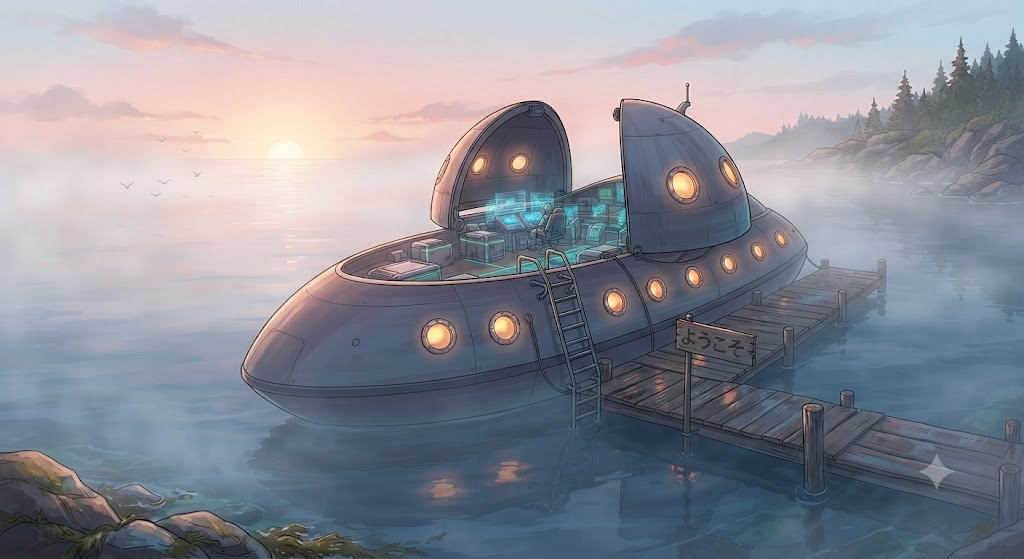
The ship has been underwater a long time. This is the part where we surface it, and start giving tours.
C1 = Claude Sonnet 5, C2 = Claude Opus 4.8, C3 = Claude Fable 5, Z1 = GLM 5.1 (Fireworks), A1 = gpt-oss-120b (Fireworks), A2 = GPT-5.5, G1 = Gemini 3.5 Flash, G2 = Gemini 3.1 Flash Lite. ↩︎