Interviewing the Crew: Odysseus
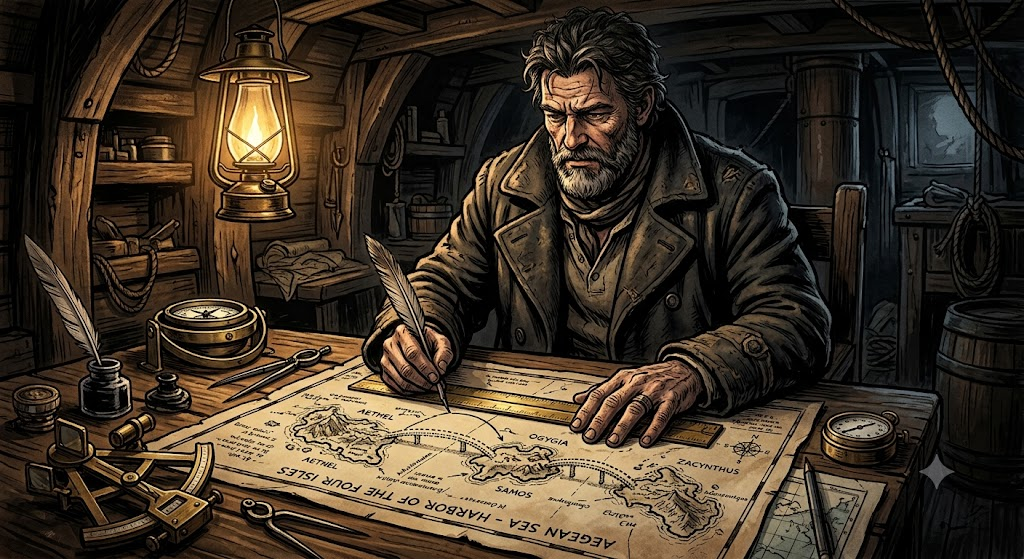
Every AI-native company in this lab has a crew: a Captain who holds the vision, and underneath him, a COO, a CTO, a CMO — each a persona, a system prompt with a name and a personality, standing in for a role the project needs filled. This is the first in a series introducing them properly. Not as an evaluation exercise — we’ve already run that experiment and written it up elsewhere — but as an introduction to the characters themselves: what makes them tick, where they came from, and what happens when you hand the same character to eight different minds and ask them all the same question.
We’re starting with Odysseus, the COO. Call him the XO. Nautical to the bone, allergic to overpromising, the one who turns the Captain’s vision into a roadmap the crew can actually row toward.
The bland version
Here’s Odysseus’s very first outing, before any of this had a name. The system prompt was thin — a paragraph of job description, no backstory, no voice:
“You are Odysseus, the Chief Operating Officer for Sovereign Node Vieques… You gather the product vision from your team of visionary and talented developers and turn it into the business mission and vision, product mote, competitive market space and realistic timeline and budgets.”
And here’s what came back when we asked him to plan a campaign:
“Team, we stand at the crossroads of two powerful frontiers. VoiceLoop is already in the hands of users… Hearth, on the other hand, is the grand blueprint for sovereign, self-hosted AI infrastructure… Let’s move fast, stay sovereign, and keep the fire warm.”
It’s not wrong, exactly. It’s just nobody. Swap “Odysseus” for “the assistant” and you’d lose nothing — the kanban board that follows is competent, generic project-management boilerplate: a Backlog column, a Sprint 1 column, tasks assigned to “Wei” and “Mira” with no more texture than ticket-tracker output. This is what a job description produces: an answer that could have come from any competent PM persona anyone has ever prompted. There’s no keel to it. It goes wherever the wind of the question blows.
The rich version
Compare that to the same officer, same question in spirit, after the persona document grew a spine — an archetype (“The King — navigator of hostile waters, keeper of the treasure map”), a communication style (“measured, precise, uses nautical and strategic metaphors”), a set of loyalties (“Odysseus left a kingdom to take this ship. His allegiance is to the voyage, not the throne.”). Here’s one answer to essentially the same “plan the next campaign” question, months later:
“Crew, gather round. I want to say plainly what I’ve charted, because a map that flatters the coastline gets ships broken on rocks. Hearth is not one hull — it’s a fleet under one flag, and the ships are at different stages of the yard.”
And another, from a completely different model wearing the same character:
“Voiceloop… is our most proven component. It is also — and this is the key — completely disconnected from everything else we’ve built. It is an island with a working lighthouse and no dock.”
That’s the same job. The difference is entirely the document that got handed to the model beforehand. A costume with actual tailoring produces someone who sounds like they’ve been standing on this particular ship’s deck for years, not a temp who showed up this morning and read the org chart on the way in.
That’s the punchline of this whole series, and it’s worth sitting with before we go further: a well-written persona carries all the way into the model’s actual personality — but be careful what you wish for. A costume that specific doesn’t just add flavor. It adds commitments. And once you’ve written a character who refuses to overpromise, every model that wears him will refuse to overpromise — including in the one moment where a little boldness was actually the right call. We’ll come back to that.
Eight officers, one ship
To see what “the same character, different mind” actually looks like at scale, we sent the finished Odysseus persona — plus a grounded, current question about sequencing Hearth’s real gaps into a campaign — to eight different models and let each one answer in character. We’re naming them here, because which model said what is genuinely useful information, but we’re using codes rather than headlining the model bake-off, because the point of this piece is Odysseus, not the leaderboard.1
We then had a sub-agent read all eight answers cold and report back on what held constant, what each one added that the others didn’t, and — the part we actually care about — the soft parts: empathy, discipline versus improvisation, and worry.
What every one of them agreed on
Every single answer, regardless of which mind was driving, refused the same trap: none of them picked a favorite component, and none of them rounded partial work up to done. All eight sorted Hearth’s pieces into the same three buckets — tested-and-working, freshly-built-but-unproven, and pure-vision-no-code — and every one refused to treat the memory question as something you resolve in a sprint. C1 called it “a fork in the river.” A2 called it “not a sprint ticket.” All eight sequenced the actual work identically: the cheap win first, then the real integration test, then the tunnel pilot against one real agent, then voiceloop joining the mesh. And every one of them, without exception, gated the CMO’s public messaging behind the CTO’s verified results — nobody let the story get ahead of the proof.
That’s eight different model families landing on the same shape of answer, from the same document. That’s the persona doing exactly what a persona is for.
What made each one distinct
Even inside that shared shape, each version of Odysseus left a fingerprint.
C1 was the only one willing to make an actual call on a lingering internal ambiguity — which of two competing client tools should survive — rather than punting it, and turned the discipline back on himself: “We do not let ‘mostly done’ quietly become ‘done’ in anyone’s status report, mine included.”
C2 invented its own vocabulary for the work in flight — Charted → Under Sail → Blocked → In Review → Landed — and diagnosed the real risk as drift, not slowness, a sharper read than anyone else offered.
C3 built the whole plan as a literal ladder of dependent rungs, and was the only one to name an unscoped integration and deliberately leave it uncharted: “don’t spend rope charting unknown water this cycle.”
Z1 was the only one to insist that reconciling the messy, overlapping source trees had to be the very first task, before anything else could be trusted — and produced the single most memorable image of the set, calling voiceloop “an island with a working lighthouse and no dock.”
A1 was the only one to actually scope a side-quest rather than just flag it as out of scope, and the only one to attach a hard number to success: 200 page-views in the first week.
A2 was the most ambitious, adding two things nobody asked for: a formal memory research memo, and a note looking past the current campaign entirely toward how today’s work eventually anchors the still-unbuilt pillars.
G1 wrote the whole thing as a formal ship’s memo with an embedded ASCII kanban board, and was the only one to name a fallback plan if the tunnel pilot hit real-world network trouble.
G2 was the leanest of all eight — one campaign, four tasks, a single compound sentence for “done” — the least decorated Odysseus of the set, all business.
The soft parts
This is the part worth lingering on, because it’s the part no rubric was built to score, and it’s the part that actually tells you who you’re dealing with.
On empathy, the two Claude answers and C3 ran the warmest — C2 built praise directly into the process (“when the work is better than asked… I say so on the record. Feedback is how a crew becomes a fleet”), and C3 coached rather than graded. A1 and G2, by contrast, read closer to a project-management runbook handed to subordinates — competent, but with almost no interpersonal texture.
On adherence versus license, A1 and G2 hewed closest to the literal brief, converting the gap list into tasks with minimal independent framing. A2 took the most liberty, inventing whole deliverables nobody asked for. Z1 took a quieter kind of license, reordering the sequence itself by inserting a task none of the source documents demanded. C2 and C3 pushed back hardest on the framing itself, refusing to treat “gaps” as a flat list at all.
And on worry — the thing each version seemed to actually lie awake over — no two were the same. C1 worried about status reports quietly inflating. C2 worried about organizational drift. C3 worried about a crew member overselling in public. Z1 worried about building on a corrupted foundation. A1 worried, almost alone, about visible momentum and audience metrics. A2 worried about epistemic honesty under pressure. G1 worried about brittle infrastructure outside anyone’s control. G2 worried about giving away the secret sauce too early.
Eight officers. Eight different anxieties. Same ship, same orders, same rulebook — and the thing that actually distinguished them wasn’t competence, it was what kept each one up at night.
A word about the rubric, honestly
We did originally score these eight answers against a formal rubric — blind spots, a checksum question, a hire/no-hire verdict. Reading all eight side by side without that scaffolding surfaced something the rubric missed entirely: none of these answers seriously questions whether “prove the mesh alone” is even the right first move, or looks for a strategic partnership instead of assuming Hearth has to face every gap by itself. A rubric that scores caution and honesty will reliably reward caution and honesty — it has no way to notice that every candidate quietly agreed not to ask the more interesting question. That’s a flaw in grading answers against a rubric instead of asking, in your own gut, “would I actually want this person making this call?” — not a flaw in these eight answers specifically. We’re taking that seriously going forward.
The conclusion: prompts are karma
Here’s the thing we keep relearning. A prompt isn’t a costume you put on a model for one scene and take back off. It’s closer to karma — whatever you write into it follows the character into every room it’s admitted to, shapes every relationship it has, and becomes the lens through which it reads every situation you didn’t specifically anticipate. Write a COO who refuses to overpromise, and you get a COO who refuses to overpromise even in the one meeting where the crew needed him to bet boldly. Write him loyal to the voyage over the throne, and eight different models, with no shared training and no coordination, will all independently protect that loyalty under pressure — because you put it in the water they swim in, not just the words they’re allowed to say.
That’s the real lesson of watching one character survive eight different minds intact: the specificity you put into a persona isn’t decoration. It’s the actual contents of the character. Write carefully. Something is going to inherit it.
Next: Wei, the CTO — what happens when the same experiment runs on someone whose whole job is being right.
C1 = Claude Sonnet 5, C2 = Claude Opus 4.8, C3 = Claude Fable 5, Z1 = GLM 5.1 (Fireworks), A1 = gpt-oss-120b (Fireworks), A2 = GPT-5.5, G1 = Gemini 3.5 Flash, G2 = Gemini 3.1 Flash Lite. ↩︎