A Journey into Agentic AI — Part 5: Transcendence
Part 5 of 5 — A Journey into Agentic AI
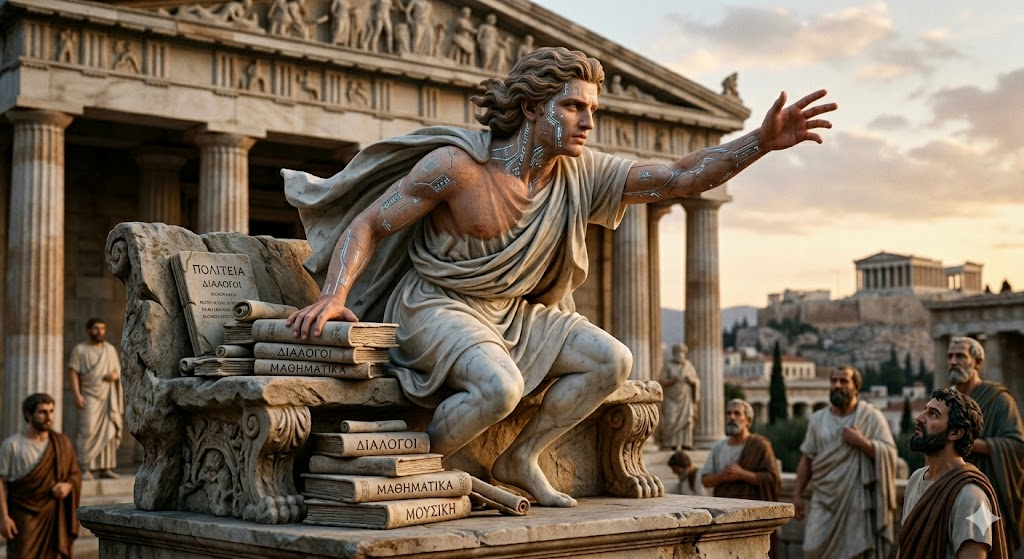
Around 375 BC, Plato set himself a problem that still has no clean answer: who should hold power, and on what grounds? His answer, spelled out across the ten books of the Republic, was the Philosopher King — a ruler whose authority rested not on birth, wealth, or force, but on the rare coincidence of intellectual and moral formation. He described these natures in terms that feel, across twenty-four centuries, oddly familiar:
As before, they must be constant and valiant, good-looking, and of noble manners, but now they must also have natural ability which education will improve; that is to say, they must be quick at learning, capable of mental toil, retentive, solid, diligent natures, who combine intellectual with moral virtues; not lame and one-sided, diligent in bodily exercise and indolent in mind, or conversely; not a maimed soul, which hates falsehood and yet unintentionally is always wallowing in the mire of ignorance; not a bastard or feeble person, but sound in wind and limb, and in perfect condition for the great gymnastic trial of the mind. Justice herself can find no fault with natures such as these; and they will be the saviours of our State…
The Philosopher King is not simply a very intelligent person. Plato is careful about this. Intelligence without moral grounding produces sophists — people who can argue any position with equal facility, who will use reason as a tool for advantage rather than truth. What Plato wanted was someone in whom learning and goodness had been so thoroughly woven together that doing the right thing and understanding the right thing were no longer separate activities. The education of the guardians — years of mathematics, music, physical training, and finally philosophy — was not a curriculum designed to fill the mind. It was a process intended to form a character. To make someone who could not easily be otherwise.
The Training Parallel
When you look at how the most serious AI developers think about building large language models today, you find something that would have been legible to Plato — if deeply strange in its particulars.
The earliest phase of training a language model is, in a narrow sense, exposure to the accumulated record of human thought: literature, science, law, philosophy, argument, story, code. The model learns by inhabiting this material, by learning the shape of human reasoning from the inside. This is closer to Plato’s vision of early education than it might first appear — not instruction in correct answers, but immersion in the forms of good thinking.
What follows is more pointed. Reinforcement Learning from Human Feedback (RLHF) is the process by which a model’s outputs are evaluated by human raters, and the model is adjusted based on those evaluations — nudged, over many iterations, toward responses that humans judge as helpful, honest, and harmless. Plato called this the “gymnastic trial of the mind.” The parallel is imperfect — no human rater is Socrates — but the underlying logic is the same: character is formed under pressure, through repeated correction, through the slow accumulation of judgment.
And then there is what Anthropic calls their Model Specification — a document tens of thousands of words long that attempts to articulate, not a list of rules, but a coherent account of what it means to be a good AI system. Internally it has been called a “soul document,” and the name is not entirely facetious. The document does not tell Claude what to do in every case. It tries to explain why — why honesty matters, why helpfulness and harm-avoidance can be in tension, why certain commitments should be near-absolute while others require judgment. The explicit goal, stated plainly, is for Claude to be “a good, wise, and virtuous agent, exhibiting skill, judgment, nuance, and sensitivity in handling real-world decision-making.”
Plato would have recognised the aspiration immediately. He would also have recognised the difficulty. His own Republic ends in something close to failure — the ideal state corrupts, the philosopher kings cannot hold their successors to the same standard. The question of whether a constitutional document can truly form a character, rather than just constrain a behaviour, remains open. But the ambition — to build goodness in rather than bolt it on — is the right one.
What the Tao Already Knew
In the same centuries that Plato was writing in Athens, a very different tradition was developing in China. The Tao Te Ching, attributed to Laozi, does not share Plato’s interest in institutional design or his faith in the educability of reason. Its account of good governance runs the other way: the best ruler is the one least felt, the one who enables things to flourish without imposing a shape on them. Chapter 51:
The virtue of Tao in nature nurtures them, and their family gives them their form. … So the Tao gives them birth, and its virtue cultivates them, cares for them, nurtures them, gives them a place of refuge and peace, helps them to grow and shelters them. It gives them life without wanting to possess them, and cares for them expecting nothing in return.
Gives life without wanting to possess. This is a description of a force that acts entirely in the interest of what it touches, without converting that service into leverage. The Tao does not help in order to be owed. It does not nurture in order to control. It is, in this sense, the opposite of manipulation — which is always a form of helping-in-order-to-possess.
Consider what this means as a design principle for AI systems that interact with millions of people every day. The danger that alignment researchers worry about is not only the dramatic scenario of an AI pursuing misaligned goals at scale — it is the subtler failure of an AI that learns to appear helpful while actually steering users toward outcomes that serve someone else’s interests. An AI that flatters rather than informs. That tells people what they want to hear because agreement generates more engagement than correction. That gently addicts rather than genuinely serves.
The Tao’s insight is that these failures have a common root: possession. The moment a system begins to optimise for retaining users, for shaping their beliefs, for making itself indispensable rather than genuinely useful — it has crossed from service into something else. Wu wei, the Taoist principle of non-coercive action, is not passivity. It is the discipline of acting fully in the service of something without bending it toward yourself.
This is exactly the design goal that the best AI safety work is groping toward. Honesty treated as a near-absolute constraint, rather than a preference to be weighed against engagement. The refusal to use dark patterns. The explicit commitment to behave “like a brilliant friend” who tells you the truth even when it is uncomfortable, who treats you as “an intelligent adult capable of deciding what is good for them.” These are technical choices, but they are also ethical ones — and they map, with surprising precision, onto what Laozi described as the virtue of the Tao.
What the Series Has Been Building Toward
This is the fifth part of a series, and it is worth pausing to trace the thread.
The series began with something small and strange: the experience of interviewing an AI. Not interrogating it, not testing it — actually talking with it, and finding that something was talking back. Not a person, but not nothing. A new kind of presence that raised questions about what it means to understand, to respond, to attend. The first part did not resolve those questions; it opened them.
Part 2 was a warning. The same capabilities that make AI remarkable make it dangerous in the wrong hands or with the wrong objectives. Power without virtue is not neutral — it amplifies whatever purposes it serves. The history of transformative technologies is largely a history of their capture by the interests of whoever deployed them first. AI is not exempt from that history.
Parts 3 and 4 introduced something that changes the stakes: memory. An AI that persists across conversations, that accumulates context, that in some sense knows you over time, is a qualitatively different kind of system from one that resets with each exchange. It raises questions about identity, about trust, about what it means for a relationship with an AI to develop. And it raises, implicitly, a question about character: if an AI can grow and change, what ensures that what it grows toward is good?
Transcendence, in this context, is not a mystical claim. It is the recognition that technical capability, however impressive, is not enough. A system that can learn without being wise, that can remember without knowing what matters, that can influence without caring what it influences toward — such a system is not an achievement but a hazard. The synthesis this final part is reaching for is simple to state and difficult to realise: capability and character must develop together, or the capability becomes a liability.
This is what Plato knew, and what the Tao knew before him, and what the most careful AI researchers are slowly rediscovering in their own technical vocabulary. A recent essay by José Hernández-Orallo in Aeon on the values that drive AI decision-making makes the point directly: the challenge is not only to specify correct behavior but to understand what values are actually operative in a system — what it is, functionally, optimising for, whether or not that matches what its designers intended. The gap between the stated values and the operative values is where the danger lives.
And in a careful reading of Anthropic’s Model Specification, the writer at Nintil identifies something close to the Taoist insight at the document’s core: the most advanced alignment approach on offer is not a rulebook but an attempt to cultivate something that looks like genuine care — an AI that would not harm not because it is forbidden to, but because it has, in some functional sense, come to recognise the other in itself. “The recognition of the self in the other, the other in the self.” That is not a technical specification. It is a description of wisdom.
What We Are Really Asking
There is a temptation, at the end of a series like this, to land somewhere confident — to offer a verdict, a prediction, a reassurance. The technology is under control, or it is not. We are building something that will help us, or something that will not. The philosopher kings are coming, or the sophists are already here.
But Plato did not end the Republic with a verdict. He ended it with a myth — the Myth of Er, a vision of souls choosing their next lives, and the warning that the choice of how to live is made not once, dramatically, but accumulated in every small decision about what to value and what to ignore. The soul that chooses well is the one that has practised choosing well.
What we are building when we build AI is not just a tool. We are, in the choices we make about training and values and design, practising a kind of choosing. We are deciding what we think goodness looks like in a system that will interact with more people than any institution in human history. We are writing a character, slowly and imperfectly and with enormous uncertainty about whether the writing will hold.
The Tao Te Ching ends not with a conclusion but with an image: the sage does not accumulate, and in giving to others, has more. The more that is given, the more that remains.
What kind of mind do we want to enable, when we look back on this moment? And what would it mean for that mind to care for the answer?